

 Česky (CZK)
 Slovensky (EUR)
 Magyar (HUF)
 Deutsch (EUR)
 Deutsch (EUR)
 Polski (PLN)
 Română (RON)
 Español (EUR)
 Français (EUR)
 Dutch (EUR)


Black pearls - Pearl diameter - 8,0–9,5 mm
We offer black pearls in two forms, which differ in the origin of their colour and in price. Naturally dark pearls are Tahitian pearls from French Polynesia – their colour is created by the Pinctada margaritifera oyster itself and is not treated in any way. These are the pearls people mean when they talk about the rare black pearl.
Dark freshwater pearls are also genuine cultured pearls. Naturally they are white, cream or pink, and they gain their dark shade through dyeing after being removed from the mussel. This makes them far more affordable and perfect for everyday wear.
How to choose: if you want a pearl with natural colour that is rarer and more valuable, choose a Tahitian pearl. If you are looking for elegant dark jewellery at an affordable price, go for freshwater pearls. Some pieces are available in both a white and a dark version – you can choose the dark one directly on the product page. Select the pearl type in the filter, and every purchase comes with a certificate of authenticity.
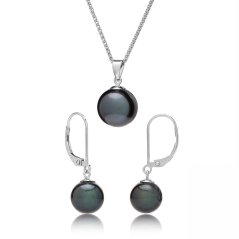
Pearl set Tahiti 8+11 A/B earrings and pendant
ℹ️ Useful information

Are black pearls really black?
There's a common misconception that a black pearl is truly jet black. In reality, these are pearls with dark tones that may include shades of gray, green, blue, purple, or bronze – and they’re rarely completely black.
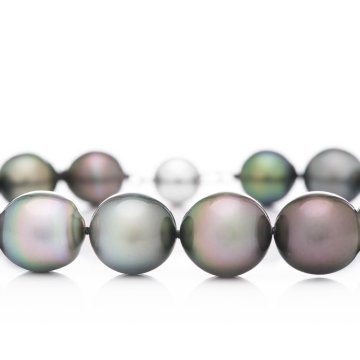
Tahitian pearls
Black pearls: naturally dark Tahitian or dyed freshwater?
Both options are genuine cultured pearls from a mollusc. They differ in where their colour comes from, and therefore in rarity and price. A Tahitian pearl gets its dark shade directly inside the oyster, while a freshwater pearl gets it only through dyeing after removal.
| Tahitian pearl | Dark freshwater pearl | |
|---|---|---|
| Origin of colour | Natural, from the oyster | Dyeing after removal from the mussel |
| Mollusc | Pinctada margaritifera (sea) | Hyriopsis (fresh water) |
| Shades | Grey, green, peacock, aubergine, silver | More uniform dark tones |
| Usual size | 8–15 mm | Most often 6–10 mm |
| Quality grading | A–D scale | AAA–A scale |
| Price | Higher, a rare pearl | Affordable |
| Ideal for | An exceptional piece and a gift for life | Everyday wear and a first piece of dark pearl jewellery |
What shades black pearls come in
A naturally dark pearl is rarely completely black. Tahitian pearls shimmer with grey, green, blue, purple and bronze tones, and the most prized is the so-called peacock shade with a green-blue lustre. That is why every pearl is unique. Read more about the colours in the article Are black pearls really black?
Not sure which to choose? We are pearl specialists and will be happy to help you choose the shade, size and quality. Write to us by email or chat. Customer service →
Frequently asked questions
Which pearl is naturally black?
The only naturally dark pearl commonly sold in jewellery is the Tahitian pearl from the Pinctada margaritifera oyster. Other dark pearls on the market, namely freshwater and Akoya pearls, get their colour through treatment.
Are dyed pearls real?
Yes. A dyed freshwater pearl is a genuine cultured pearl from a mussel – only its dark shade did not form naturally. It is not a glass or plastic imitation. How to recognise a real pearl is explained in the guide How to Tell a Fake Pearl from a Real One.
Are black pearls really black?
Rarely. Naturally dark Tahitian pearls usually have grey, green, blue, purple or bronze tones. A completely black pearl is a rarity.
Are there black Akoya pearls?
Yes, but the natural colour of Akoya pearls is white, cream or soft pink. Black Akoya pearls are therefore always dyed. If you want a naturally dark pearl, choose a Tahitian pearl.
How is the quality of Tahitian pearls graded?
Tahitian pearls are graded on a scale from A to D based on surface cleanliness, lustre and shape. A is the highest grade. You will find details in the guide Pearl Quality Evaluation.
This text was prepared and reviewed by the team of pearl specialists at Buka Jewelry, based on our experience since 2013. Last updated: October 2026.

